André Dedieu
The world behind the novel
Occitania & the Cathars
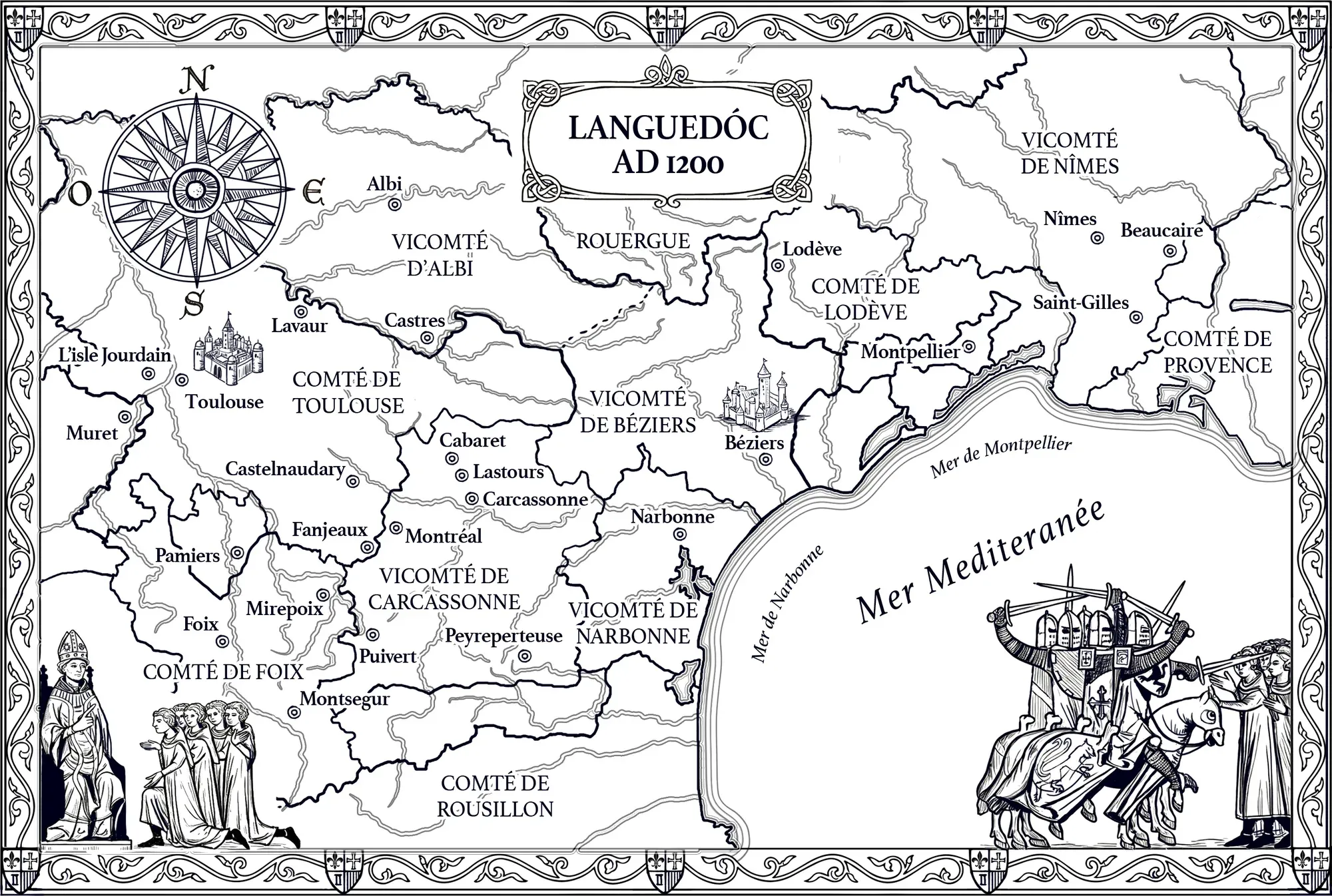
The novel is set in Occitania, a sophisticated and forward-thinking society, which in medieval times stretched from the Mediterranean Sea and the Pyrenees in the south of France to beyond Limoges in the north, and from the Atlantic Ocean in the west to the Alps in the east. Never an independent kingdom or country, it was a linguistic and cultural entity where Occitan, a romance language similar to Catalan was spoken.
In contrast to a rigidly feudalistic society, Occitania comprised independent semi-autonomous regions that were controlled by counts and viscounts; elected officials administered many of the towns; a code of ethics called Paratge was the foundation of society; religious tolerance was practiced; women had certain rights; social mobility was allowed, and it was the birthplace of the troubadours who invented Western European lyric poetry. They sang of Fin’Amors, that spiritual transcendence was possible through the transformative power of love.
It was also a land where an alternative form of Christianity was threatening the power and absolute control of the Roman Church. People from all levels of society embraced the philosophy of the Cathars, who called themselves Good Christians and presented an antithesis to the corruption and materialism of Rome. In retaliation, Pope Innocent III waged the Albigensian Crusade from 1209 to 1229, which resulted in the death of over one million people, devastated the economy, destroyed the culture, and crushed the philosophy that had threatened the status quo.
Languedóc, AD 1200